
New Customers Get 10% Off – Use Code: LUX10

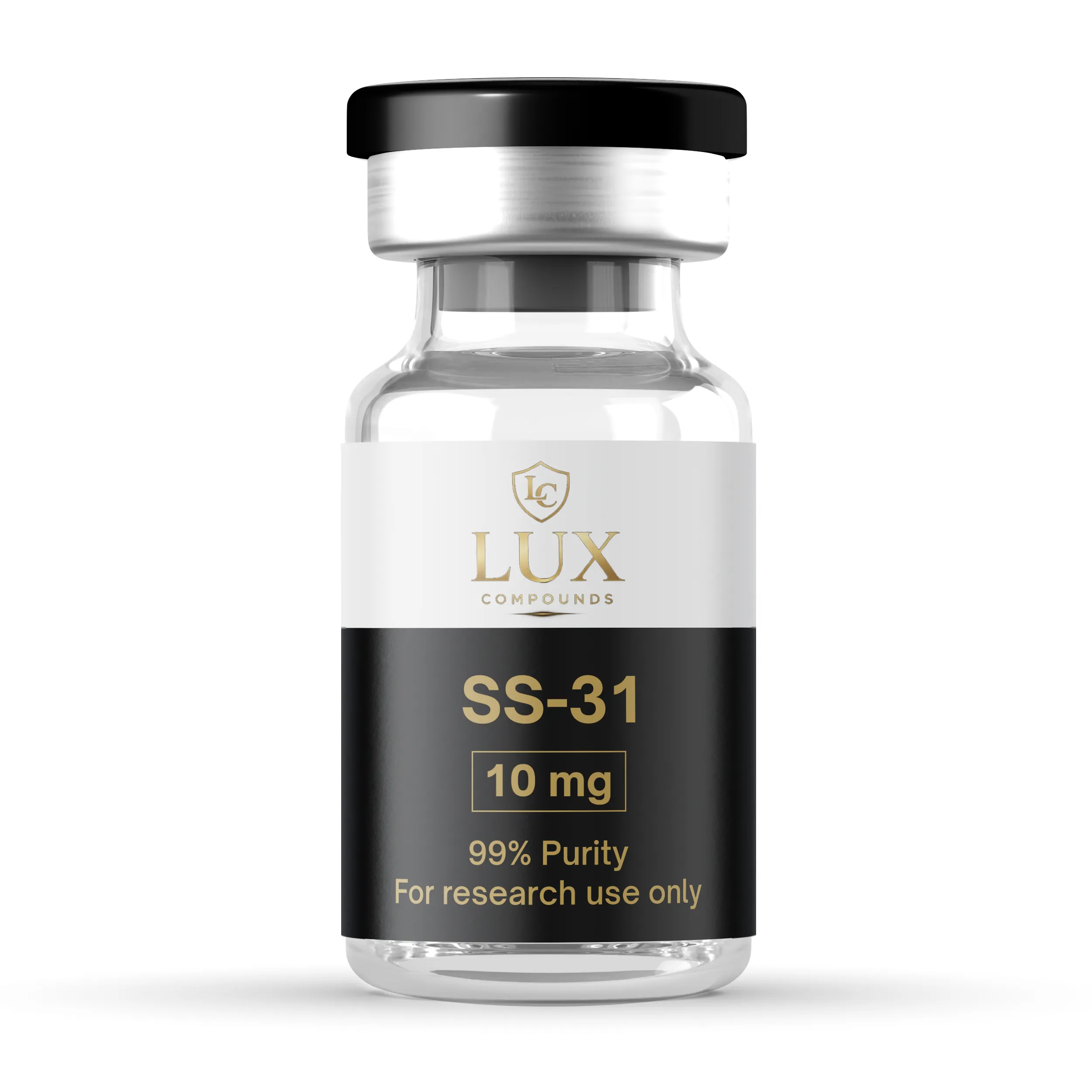
SS-31

5.0 Reviews

A mitochondria-targeted synthetic tetrapeptide studied for its association with the inner mitochondrial membrane and cardiolipin interactions in laboratory research models. For laboratory research use only.

All products currently listed on this site are for research purposes only.

Original price was: $75.00.Current price is: $67.99.

2 Day FAST Shipping

99%+ Purity Tests

Ships from USA

USA Lab Tested

We accept :

Certificate of Analysis

Third Party Tested by Freedom Diagnostics

How SS-31 Works

The Science, Simplified

Targeted Cardiolipin Stabilization

SS-31 is a synthetic, water-soluble tetrapeptide that selectively targets and binds to cardiolipin, a unique phospholipid located exclusively within the inner mitochondrial membrane.
Key insight: Cardiolipin is responsible for maintaining the structural curvature of the inner mitochondrial membrane and anchoring the electron transport chain (ETC) complexes. In research models exposed to oxidative stress, cardiolipin degrades and the inner membrane loses structural integrity. SS-31 acts as a molecular scaffolding agent, binding to cardiolipin via electrostatic and hydrophobic interactions to stabilize the membrane structure and support electron transport chain organization as observed in laboratory research models.

Prevention of Electron Leakage & ROS Reduction

When cardiolipin is damaged, the physical spacing between the ETC complexes expands, leading to electron leakage and a massive surge in Reactive Oxygen Species (ROS).

Key insight: By re-anchoring cardiolipin, SS-31 optimizes the physical architecture of the ETC ($Complexes\ I\ to\ IV$). This structural alignment dramatically reduces electron leakage, stopping the overproduction of harmful free radicals at the source (the mitochondria) rather than just scavenging them downstream like typical antioxidants.

ATP Synthesis Restoration

Mitochondrial decay directly drops the cell's ability to produce Adenosine Triphosphate (ATP), leading to cellular fatigue, tissue aging, and organ failure.

Key insight: In ischemic and aging tissue models, SS-31 has shown the unique ability to rapidly ramp up ATP production back to youthful baselines. Because it fixes the underlying structural machinery of the cell, it serves as a premier research subject for treating age-related muscle wasting, acute kidney injury (AKI), and heart failure.

Research Handling Notes

What research literature describes

Handled as a research chemical under standard laboratory protocols.

🧿 Storage & Handling

30%

Store lyophilized at -20°C

note

12%

Reconstitute with bacteriostatic water for laboratory use

note

10%

Protect from light

note

Selectivity Profile

Bioenergetic Selectivity

Compound Information

Technical specifications for this mitochondrial tetrapeptide

🔬 Molecular Profile

What Is SS-31?

Full Chemical Name

Elamipretide (SS-31)

Sequence

D-Arg-Dmt-Lys-Phe-NH2

Molecular Weight

639.8 g/mol

Chemical Formula

$C_{32}H_{49}N_{9}O_{5}$

Primary Target

Cardiolipin / Inner Mitochondrial Membrane

🧊 Storage Requirements

Stability Information

Lyophilized (powder)

Store at -20°C

up to 24 months

Reconstituted solution

Store at 2–8°C

use within 14–30 days

Handling Notes

Protect from heat and direct light

📊 Physical Properties

Research Status

Classification

Mitochondria-Targeted Research Peptide

Clinical Stage

Phase III Active Trials (Barth Syndrome, Mitochondrial Myopathy)

Primary Vectors

Ischemia-Reperfusion Injury, Neurodegeneration, Mitochondrial Dysfunction

US Regulatory Status

Research Chemical Only

Frequently Asked Questions

Common questions about SS-31

No. Standard antioxidants float around the cell waiting to pick up loose free radicals that have already been released. SS-31 is a "mitochondrial-targeted" peptide. It travels directly into the inner mitochondrial membrane to fix the structural leaks, stopping the overproduction of free radicals before they can ever form.
Cardiolipin is the phospholipid that anchors the mitochondrial energy-transport structures within the inner membrane. In research models, when it is damaged the inner membrane loses structural integrity. SS-31 binds to cardiolipin, acting as a structural brace that stabilizes it in laboratory research models.
While both are associated with mitochondria, they operate through different pathways. MOTS-c acts as a signaling peptide associated with the AMPK pathway. SS-31 is studied purely for structural mechanics, associating with cardiolipin and the inner mitochondrial membrane in laboratory research models.
Yes, extensively. Because it easily crosses the blood-brain barrier due to its unique chemical charge, it is a primary subject for research involving neurodegenerative conditions like Alzheimer's, Parkinson's, and traumatic brain injuries, where mitochondrial decay is a core issue.
No. It remains classified globally as an investigational research chemical, known in the literature under the name Elamipretide, and is provided strictly for laboratory analysis.

Sources & References

Peer-reviewed research

Not for human consumption. This product is sold exclusively for research and educational purposes. It is not intended to diagnose, treat, cure, or prevent any disease.

All research data and findings presented on this page are sourced from peer-reviewed journals and official publications. They are provided for educational reference only and should not be interpreted as medical advice or product claims.

By purchasing this product, you confirm that you are a qualified researcher and will use it in accordance with all applicable laws and regulations.
