
New Customers Get 10% Off – Use Code: LUX10

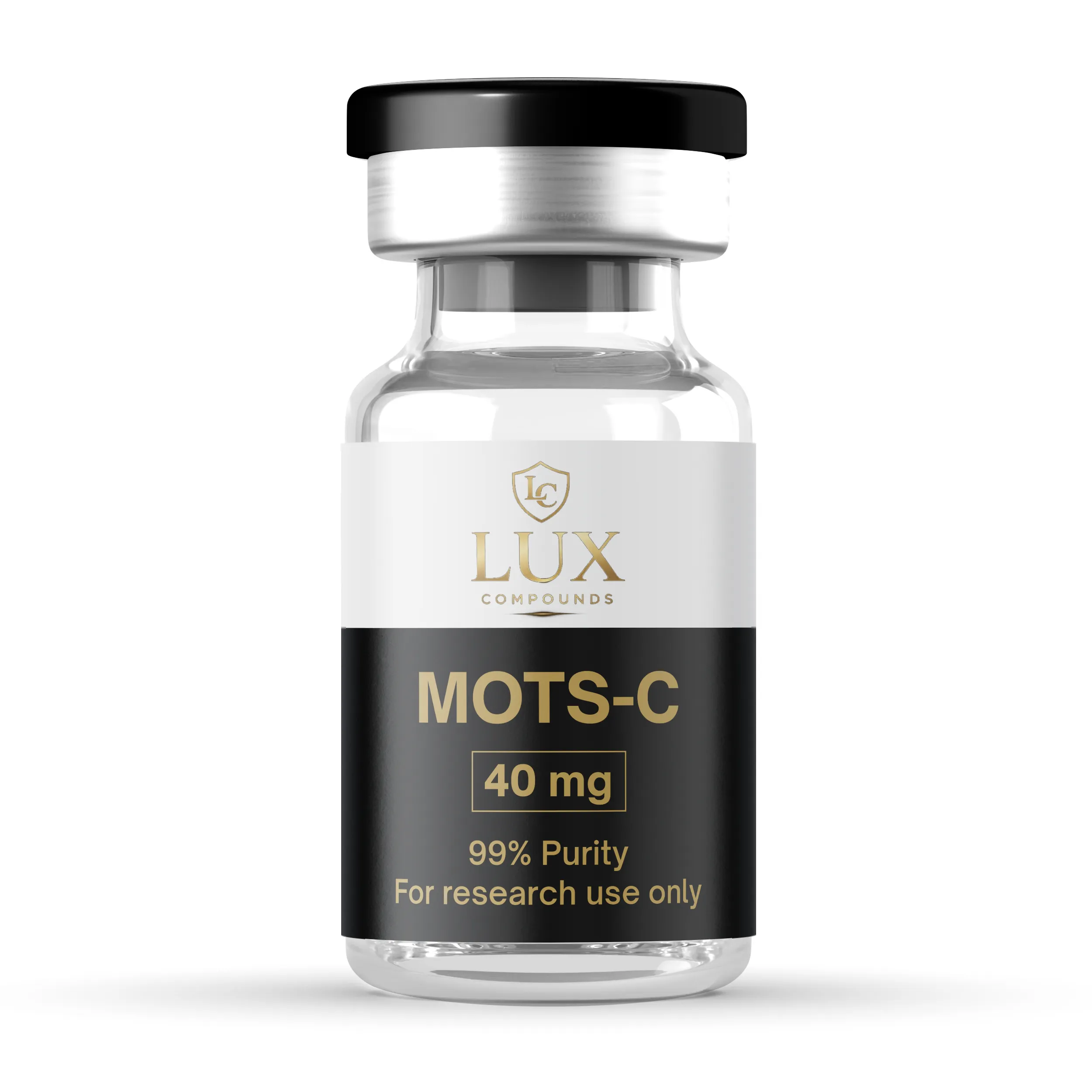
MOTS-C

5.0 Reviews

Mitochondrial ORF of the 12S rRNA type-cMOTS-CMRWQEMGYIFYPRKLRPeptide

A mitochondria-derived peptide encoded within the 12S rRNA region, studied for AMPK-pathway and metabolic signaling in rodent research models. Premium Research Peptide.

All products currently listed on this site are for research purposes only.

Price range: $62.99 through $239.99

2 Day FAST Shipping

99%+ Purity Tests

Ships from USA

USA Lab Tested

We accept :

Certificate of Analysis

Third Party Tested by Freedom Diagnostics

How MOTS-C Works

The Science, Simplified

The Master Metabolic Switch

MOTS-c is a 16-amino acid peptide encoded within the mitochondrial genome rather than the cell nucleus. Its primary action studied in research is the activation of AMPK (AMP-activated protein kinase), a central regulatory node in cellular energy metabolism.
Key insight: In rodent research models, MOTS-c administration has been associated with “exercise mimetic” signaling patterns, characterized by activity in metabolic pathways similar to those engaged during physical activity. One published study reported increased running time and running distance in aged mice treated with MOTS-c relative to controls.

Glucose Uptake & Insulin Sensitivity

By targeting the Folate-AICAR-AMPK pathway, MOTS-c is studied for its role in glucose uptake into skeletal muscle and fatty acid oxidation in research models

Key insight: Research has examined MOTS-c signaling in the context of diet-induced metabolic changes and insulin-pathway activity in middle-aged research models. Across published data, endogenous MOTS-c levels have been reported as lower in certain metabolic and age-related research cohorts, a correlation studied in the context of metabolic aging research.

Nuclear Gene Regulation

Unique among peptides, MOTS-c can translocate to the cell nucleus during times of metabolic stress to regulate the expression of nuclear genes.

Key insight: This “retrograde signaling” describes how the mitochondria communicate with the nucleus in models of metabolic adaptation. This mechanism is being researched in relation to vascular calcification pathways and osteoclast-regulated bone cell signaling.

Research Handling Notes

What research literature describes

MOTS-c is characterized in preclinical research as an endogenously expressed mitochondrial-derived peptide, identified in mammalian plasma and skeletal muscle tissue.

🧿 Laboratory Handling Notes

15%

Store lyophilized at -20°C

standard

10%

Reconstitute with bacteriostatic water for laboratory use

standard

8%

Protect from light

standard

Safety Advantage

Non-Suppressive Elevation

Compound Information

Technical specifications for this 25mg capsule format

🔬 Molecular Profile

What Is MOTS-c?

Type

Mitochondrial-derived peptide

Amino Acids

16

Sequence

MRWQEMGYIFYPRKLR

Molecular Weight

2,174.6 g/mol

Formula

C101H152N28O22S2

Encoded in

12S rRNA (mtDNA)

🧊 Storage Requirements

Stability Information

Lyophilized (powder)

-20°C

stable long-term

Reconstituted

2-8°C

use immediately

Room temperature

Degrades 85-90% in 2-3 hrs

📋Research Status

Development History

Classification

AMPK-Pathway / Metabolic Research Peptide

Primary Target

AMPK Pathway / Skeletal Muscle

US Status

Investigational Research Compound

Key Research

Metabolic Aging, Hepatic Lipid Signaling, Mitochondrial Research

Frequently Asked Questions

Common questions about MOTS-C

They act on different pathways in research models. Cardarine is studied for PPAR-delta pathway activity, while MOTS-c is studied for AMPK pathway activation. In the literature, MOTS-c is often described as more "foundational" because it is an endogenously encoded mitochondrial signaling peptide, whereas Cardarine is a synthetic SARM-like research compound.
Because in research models it has been observed to activate cellular metabolic pathways similar to those engaged during high-intensity aerobic exercise, including pathways related to fat oxidation and glucose uptake.
Yes, it is a major focus of longevity research. Published studies have reported that aged mice administered MOTS-c in research settings showed an increase in median lifespan of 6.4% and measurable differences in physical performance metrics in later-life research models.
For laboratory research use only: it should be kept in the freezer until the exact moment of research use. Once reconstituted with bacteriostatic water for laboratory use, it should be used as soon as possible, as its biological activity begins to drop rapidly once it is no longer in its freeze-dried state.
No. It was only discovered in 2015 at USC. While synthetic analogs are referenced in early-phase pharmacological literature, MOTS-c itself remains an investigational research compound, sold for laboratory research use only and not approved for human use.

Sources & References

Peer-reviewed research

Not for human consumption. This product is sold exclusively for research and educational purposes. It is not intended to diagnose, treat, cure, or prevent any disease.

All research data and findings presented on this page are sourced from peer-reviewed journals and official publications. They are provided for educational reference only and should not be interpreted as medical advice or product claims.

By purchasing this product, you confirm that you are a qualified researcher and will use it in accordance with all applicable laws and regulations.
