
New Customers Get 10% Off – Use Code: LUX10

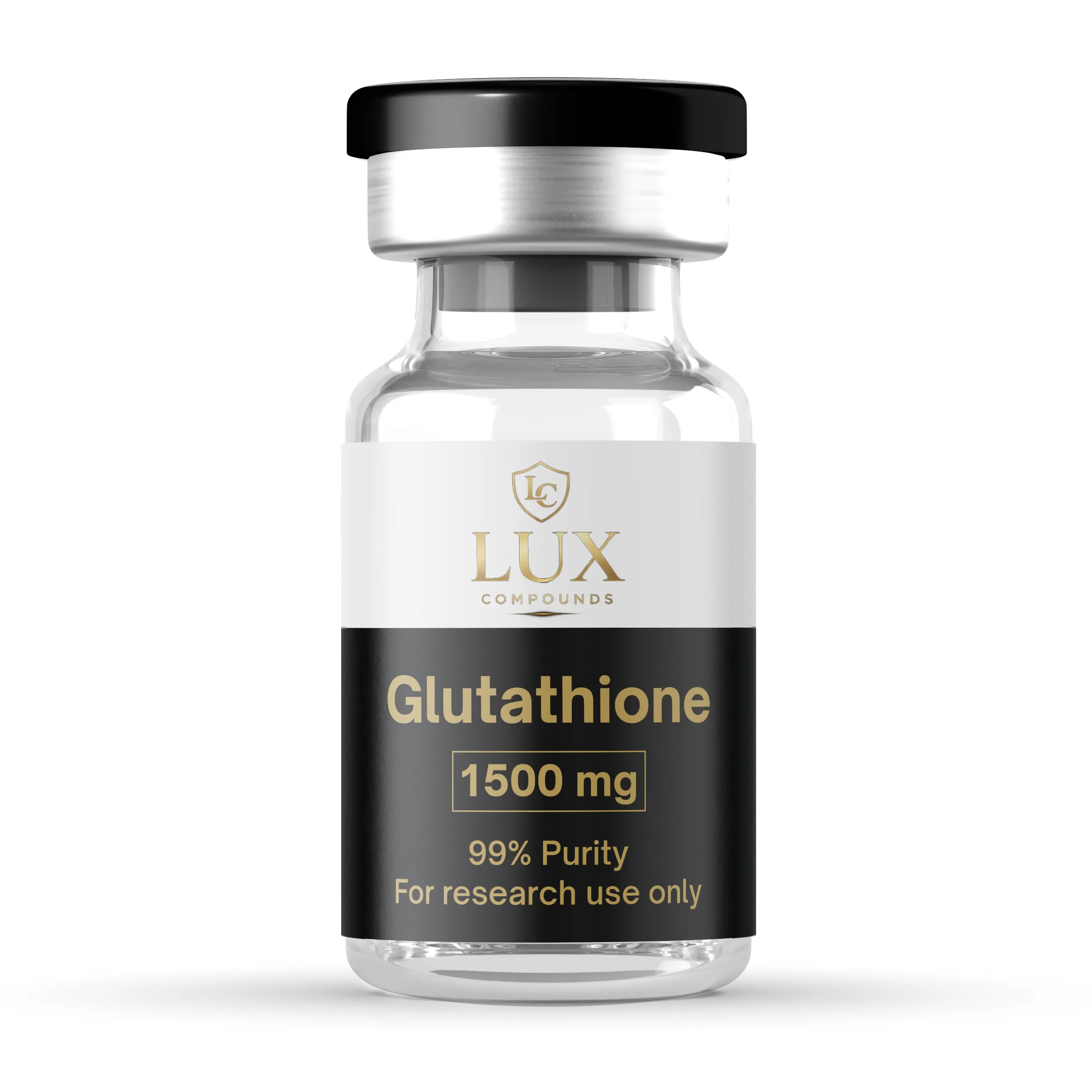
Glutathione

5.0 Reviews

GSHL-GlutathioneReduced Glutathioneγ-L-Glutamyl-L-cysteinyl-glycine

A naturally occurring 3-amino-acid tripeptide (γ-Glu-Cys-Gly, GSH) studied in cell models for its role in intracellular redox chemistry and reactive-oxygen-species handling. For laboratory research use only.

All products currently listed on this site are for research purposes only.

Original price was: $100.00.Current price is: $90.00.

2 Day FAST Shipping

99%+ Purity Tests

Ships from USA

USA Lab Tested

We accept :

Certificate of Analysis

Third Party Tested by Freedom Diagnostics

How Glutathione Works

The Science, Simplified

Direct Free Radical Scavenging (Research Models)

Glutathione (GSH) is a tripeptide composed of three amino acids: L-glutamate, L-cysteine, and glycine. Its defining chemical feature is the reactive sulfhydryl (-SH) thiol group on its central cysteine residue.
Research observation: In cell-model studies, this thiol group acts as an electron donor to reactive oxygen species (ROS) and free radicals. This electron-transfer reaction is studied in relation to oxidative modification of cellular lipids, proteins, and DNA under metabolic conditions.

The Redox Mechanism (Research Models)

When glutathione donates an electron to a free radical, it becomes oxidized. Two oxidized glutathione molecules bond together via a disulfide bridge to form Glutathione Disulfide (GSSG).

Research observation: GSSG is regenerated back to GSH in this pathway. The enzyme Glutathione Reductase uses an NADPH cofactor to reduce GSSG into two molecules of GSH. In tissue-model samples, the ratio of reduced to oxidized glutathione ($GSH/GSSG$) is typically skewed toward reduced GSH ($>100:1$). A drop in this ratio is studied as a laboratory biomarker of oxidative stress in cell models.

Phase II Conjugation (Research Models)

Glutathione is a primary substrate for Glutathione S-Transferases (GST), a family of enzymes studied in hepatic tissue models for their role in Phase II conjugation of xenobiotic substrates.

Research observation: In enzymatic assays, GST conjugates the thiol group of glutathione to xenobiotic substrates such as heavy metals, environmental pollutants, or drug metabolites. This conjugation increases the water solubility of the substrate, a step studied in relation to biliary and renal excretion pathways.

Research Handling Notes

What research literature describes

Glutathione is an endogenous molecule present in most cell types; it is handled as a stable research compound with a well-characterized structure.

🧿 Handling & Storage Notes

6%

Store lyophilized at -20°C

mild

4%

Reconstitute with bacteriostatic water

mild

<1%

Protect from light exposure

mild

Structural Notes

Endogenous Structure

Compound Information

Chemical and structural properties

🔬 Molecular Profile

Glutathione Structure

CAS Number

70-18-8

Molecular Formula

C10H17N3O6S

Molecular Weight

307.32 g/mol

Type

Tripeptide (γ-Glu-Cys-Gly)

Sequence

γ-L-Glutamyl-L-cysteinyl-glycine

Active moiety

Cysteine thiol (-SH) group

🧊 Storage Requirements

Stability Information

Appearance

White crystalline powder

Solubility

Freely soluble in water

Storage (powder)

-20°C

protected from light

Reconstituted

Use promptly

refrigerate

📊 Physical Properties

Research Status

Classification

Endogenous Tripeptide / Non-Enzymatic Antioxidant

Primary Vectors

Redox Reactions, Xenobiotic Conjugation, Thiol Chemistry

Regulatory Profile

Research Compound / Not for Human or Animal Use

Research Scope

Oxidative-Stress Research, Redox Biology

Frequently Asked Questions

Common questions about Glutathione

In the research literature, the term reflects glutathione's position within the intracellular redox network. Unlike molecules such as ascorbate or tocopherol, glutathione is enzymatically regenerated within the GSH/GSSG redox pathway and is studied as a substrate that participates in the regeneration of other redox-active compounds in cell models.
Reduced Glutathione (GSH) is the electron-donating state carrying a free thiol group. Oxidized Glutathione (GSSG) is the disulfide-bonded state formed after electron transfer. A high GSSG concentration in a laboratory sample is studied as an indicator of elevated oxidative stress within the cell model.
Unmodified glutathione powder is chemically fragile and the tripeptide bond is readily cleaved by peptidases in solution. For consistent in-vitro work, laboratories use the ultra-pure lyophilized form, which offers greater stability of the tripeptide bond during reconstitution and handling in cell-model studies.
In enzymatic and cell-model studies, glutathione has been reported to down-regulate the enzyme tyrosinase. In melanocyte models, tyrosinase inhibition is associated with a shift in melanin synthesis from eumelanin toward pheomelanin. These observations are documented as biochemical research findings only.
Glutathione is a naturally occurring compound that is not a controlled substance. In its ultra-pure, raw lyophilized format it is studied across academic institutions in tissue-culture and redox-biology research. It is supplied for laboratory research use only and is not for human or animal use.

Sources & References

Peer-reviewed research

For laboratory research use only; not for human or animal use. This product is sold exclusively for research and educational purposes. It is not intended to diagnose, treat, cure, or prevent any disease.

All data and research findings presented on this page are sourced from peer-reviewed journals and official publications. They are provided for educational reference only and should not be interpreted as medical advice or product claims.

By purchasing this product, you confirm that you are a qualified researcher and will use it in accordance with all applicable laws and regulations.
