5.0 Reviews
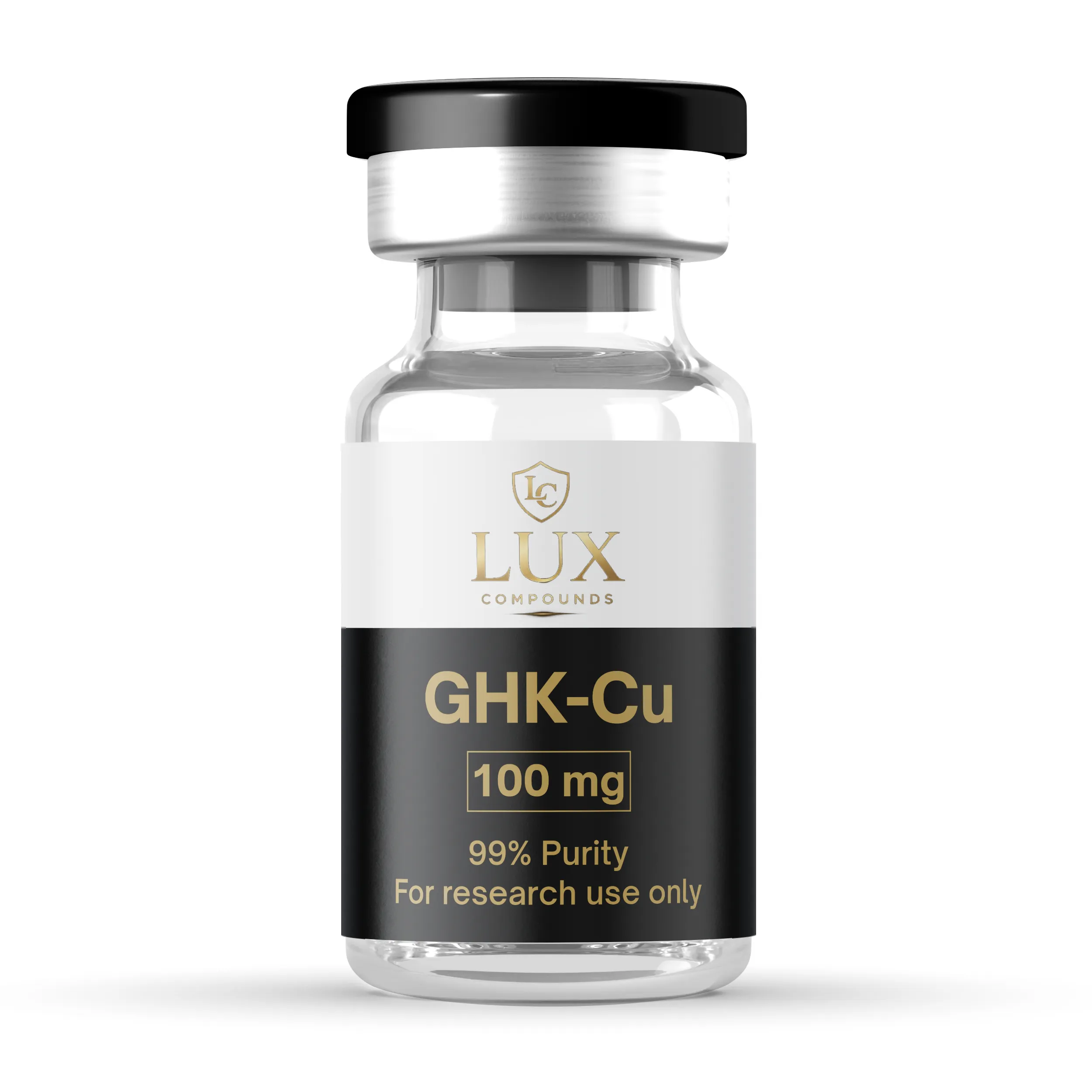
Copper Tripeptide-1Glycyl-L-histidyl-L-lysine Copper C
A naturally occurring copper tripeptide (3 amino acids + Cu²⁺) studied in vitro and in cell-culture models for its interaction with extracellular-matrix and collagen-synthesis pathways. For laboratory research use only.
All products currently listed on this site are for research purposes only.
$45.00 – $65.00Price range: $45.00 through $65.00
We accept :

Third Party Tested by Freedom Diagnostics
The Science, Simplified
Research note: In in-vitro dermatological research models, GHK-Cu has been studied for its association with fibroblast collagen synthesis.
Research note: In research models, copper stabilization by GHK-Cu has been associated with modulation of lipid peroxidation and pro-inflammatory cytokines such as TNF-α and IL-6.
Research note: In controlled in-vitro studies, GHK-Cu has been studied for its association with follicular cell activity via a distinct molecular mechanism.
What research literature describes
GHK-Cu is one of the most extensively characterized tripeptides in the research literature; it occurs naturally in biological systems and is handled as a stable research compound.
🧿 Handling & Storage Notes
Store lyophilized at -20°C
mild
Reconstitute with bacteriostatic water
Transient
Protect from light exposure
mild
Research Characteristics
Molecular Efficiency
Technical specifications for each component
🔬 Molecular Profile
What Is GHK-Cu?
CAS Number
89030-95-5
Molecular Weight
340.38 g/mol (free peptide)
Molecular Weight (Cu)
401.91 g/mol (with copper)
Amino Acids
3 (tripeptide)
Sequence
Gly-His-Lys
Formula
C₁₄H₂₄N₆O₄·Cu
🧊 Storage Requirements
Stability Information
Lyophilized (powder)
-20°C
up to 2 years
Reconstituted
2-8°C •
up to 30 days
📋 Research Status
Where Each Stands
Classification
Dermal & Extracellular-Matrix Research Compound
Origin
Human Plasma (Discovered 1973)
GHK-Cu studies
4,000+ publications
Cited studies
50+ published studies
Common questions about GHK-Cu
Peer-reviewed research
Journal of Cosmetic Science
A 12-week, double-blind, placebo-controlled study of GHK-Cu facial cream
2005
Finkley et al.
Journal of Cosmetic Laser Therapy
Stimulation of collagen production by copper-peptide complex
2007
Appa Y et al.
Journal of Aging Science and Clinical Practice
Effects of GHK-Cu in nano-carriers on MMP expression and facial dermal parameters
2009
Gorouhi F, Maibach HI
Archives of Facial Plastic Surgery
Effects of Topical Copper Tripeptide Complex on CO2 Laser-Resurfaced Skin
2006
Miller TR et al.
Various Sources
GHK-Cu effects on hair follicle growth and size
2020
Multiple researchers
Multiple Sources
GHK-Cu physicochemical and reconstitution characterization
2018
Various research sources
Journal of Cosmetic Dermatology
Anti-inflammatory effects of GHK-Cu
2012
Campbell JD et al.
For laboratory research use only; not for human or animal use. This product is sold exclusively for research and educational purposes. It is not intended to diagnose, treat, cure, or prevent any disease.
All research findings presented on this page are sourced from peer-reviewed journals and official publications. They are provided for educational reference only and should not be interpreted as medical advice or product claims.
By purchasing this product, you confirm that you are a qualified researcher and will use it in accordance with all applicable laws and regulations.